A mobile-friendly web directory which lists websites to help them get discovered by users and search engines.

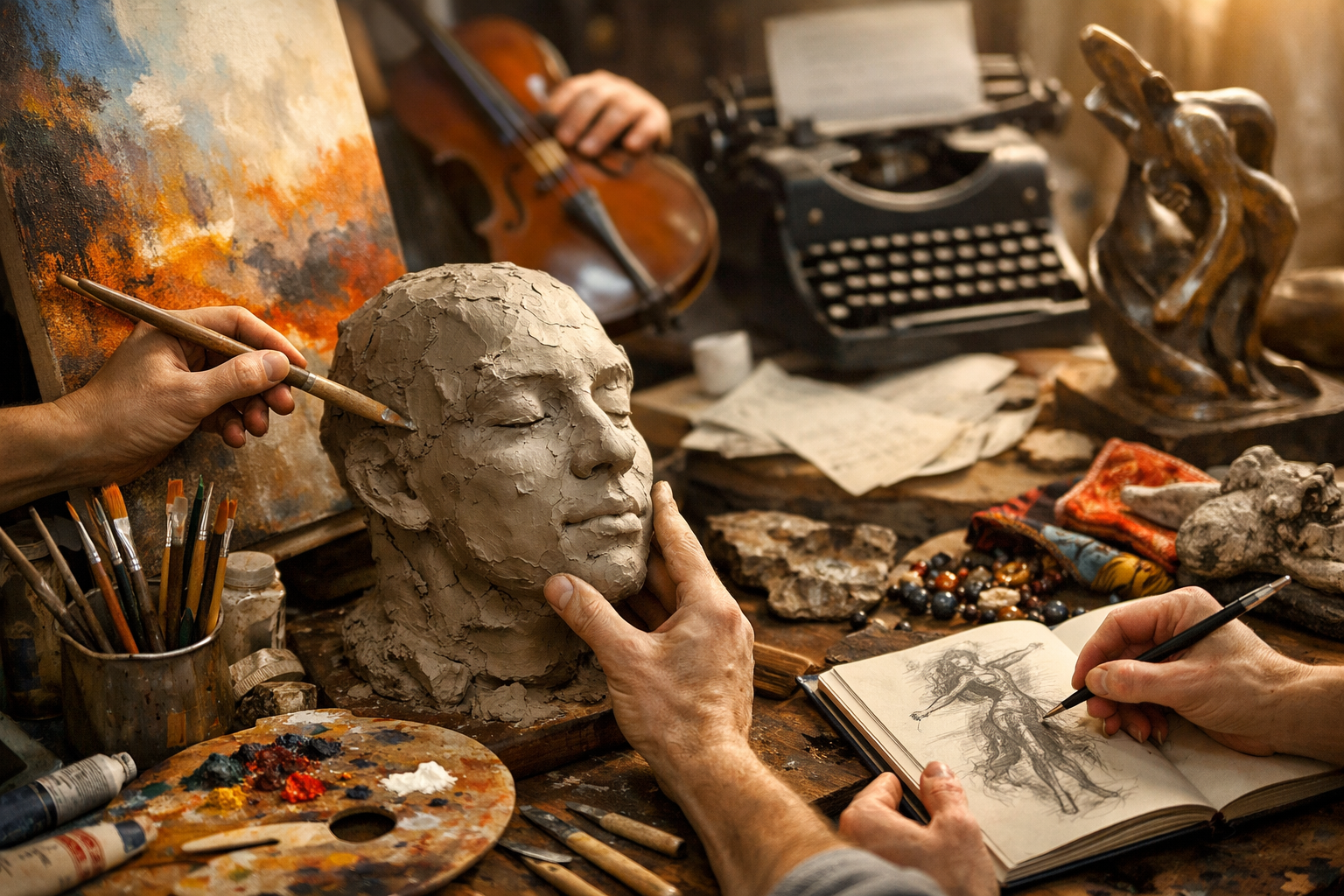
The arts are the many ways people translate experience into form—images, sounds, movements, words, and designed objects that carry meaning beyond their practical function. While “art” can refer to a single work, “the arts” describes a broad ecosystem of practices: painting, sculpture, music, dance, theater, literature, film, architecture, crafts, and newer digital and interactive media. Across cultures and eras, the arts have served as record, ritual, protest, celebration, and experiment. They are both intensely personal and deeply social, because they turn private feeling into something others can witness, interpret, and respond to.
Arts are often grouped into categories to help us talk about them, even though many works blend multiple forms. These branches are less like sealed boxes and more like neighboring languages that borrow vocabulary from each other.
Visual arts communicate primarily through what we see: color, line, texture, scale, and composition. Traditional visual arts include drawing, painting, printmaking, photography, sculpture, and ceramics. Contemporary practice expands into installation art, street art, and mixed media, where everyday materials are transformed into storytelling tools. Visual arts can focus attention on overlooked details—light on a wall, a worker’s hands, a city’s layered history—and can make abstract ideas feel immediate through symbols and visual metaphor.
Performing arts unfold in time, often in front of an audience: theater, dance, music, opera, and performance art. They rely on presence—bodies, voices, and the shared atmosphere of a room. A performance can be meticulously choreographed or partly improvised; in either case, it creates meaning through rhythm, gesture, timing, and emotional pacing. Even recorded concerts and streamed plays carry traces of live performance: breath, tempo, and the subtle unpredictability of human expression.
Literary arts shape language into experience. Poetry compresses meaning with sound and imagery; fiction builds worlds and moral dilemmas; nonfiction can document reality with narrative force; drama writes actions meant to be embodied on stage. Through reading, we practice empathy and interpretation: we infer motives, weigh perspectives, and notice how a single word choice changes the temperature of a scene. Literary arts also preserve voice across time, allowing conversations between generations that never meet.
Design and architecture sit at the intersection of aesthetics and function. From typography and product design to public buildings and urban spaces, these arts influence how we move, work, and feel in daily life. The applied arts—fashion, furniture, crafts, and decorative traditions—demonstrate that beauty and usefulness are not opposites. A well-made object can carry cultural identity, technical mastery, and sustainable thinking all at once.
The value of the arts is not limited to the marketplace or to museum walls. Arts matter because they develop capacities that societies depend on: attention, interpretation, emotional intelligence, and imaginative problem-solving.
Art speaks through form (how something is made) and context (where it comes from and how it’s encountered). In a painting, form includes composition, contrast, and brushwork; in music, it includes harmony, rhythm, and timbre; in dance, it includes weight, space, and dynamics. Context includes the artist’s intent, cultural background, historical moment, patronage, and the setting in which an audience meets the work.
Interpretation is not about finding a single “correct” answer. Instead, it’s a disciplined kind of looking and listening. A strong interpretation connects observations (“the lighting isolates the subject”) to plausible meanings (“the isolation suggests vulnerability or authority”) while staying open to other readings. This openness is one reason the arts remain relevant: they don’t just deliver messages—they invite dialogue.
Technology has not replaced the arts; it has multiplied the ways art can be made and shared. Digital painting, 3D modeling, electronic music, animation, game design, and interactive installations extend creative possibilities. Online platforms allow artists to reach audiences without traditional gatekeepers, while also raising new questions about attention, ownership, and sustainability.
Digital culture also blurs boundaries: filmmakers borrow from video essays, musicians collaborate across continents, and museums offer virtual exhibitions. At the same time, hands-on traditions persist—printmaking, weaving, and analog photography thrive precisely because tactile processes offer a different kind of time and focus than screen-based life.
Engaging with the arts is less about talent and more about curiosity and consistency. You don’t need to be an expert to build a meaningful relationship with art; you need permission to start.
The arts are not a luxury added after “real life” is handled; they are one of the ways real life becomes understandable. They help us face grief and joy, question power, imagine futures, and honor what words alone cannot hold. Whether encountered in a concert hall, on a phone screen, in a library, or on a neighborhood wall, the arts remind us that meaning is made—carefully, boldly, and together.
