A mobile-friendly web directory which lists websites to help them get discovered by users and search engines.

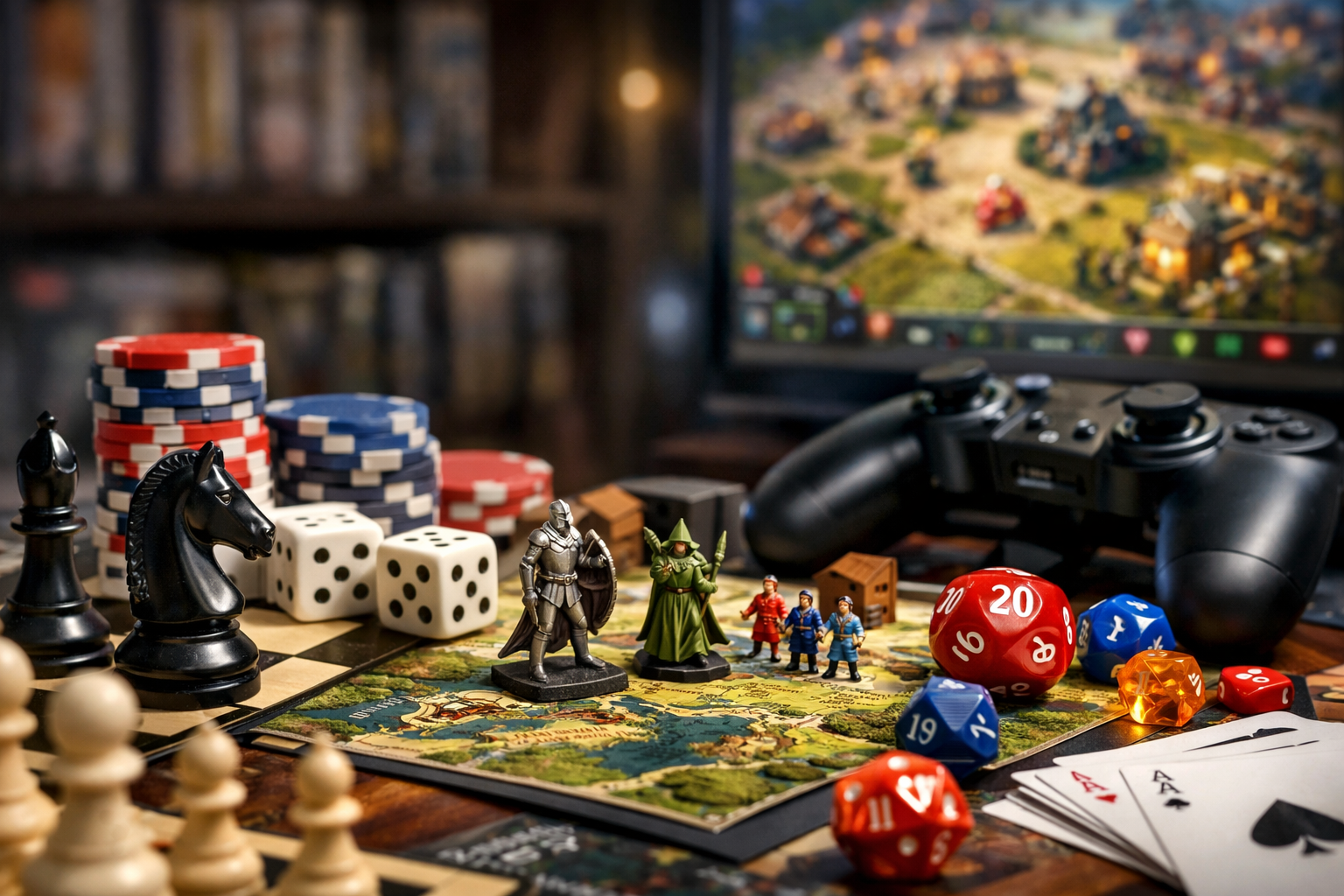
At their core, games are structured experiences built from rules, goals, and meaningful choices. Whether it’s a quick card game at a kitchen table or a sprawling online world, games create a “magic circle” where players agree to constraints and pursue outcomes within a defined system. That system can be competitive, cooperative, expressive, or purely exploratory, but it typically includes feedback (points, progress, success/failure states) that helps players understand how their actions shape results.
Games also serve as a bridge between play and problem-solving. They reward experimentation, encourage pattern recognition, and provide safe spaces to take risks—qualities that explain their lasting appeal across ages and cultures.
Games come in many forms, and categories often overlap. Still, these broad groupings help explain how different experiences are designed and why they attract distinct audiences.
Analog games rely on physical components—cards, boards, dice, miniatures—and face-to-face social interaction. Their strengths include clarity of rules, tactile satisfaction, and strong social presence. Modern tabletop design has expanded far beyond classic roll-and-move formats into strategy “Eurogames,” narrative-driven campaigns, and cooperative puzzles where players work against the game itself.
Video games leverage real-time feedback, audiovisual immersion, and complex simulation. They range from single-player stories to competitive esports and massive online worlds. Unlike most analog games, digital games can automate rules, track hidden information, and create dynamic environments that react to player behavior.
Tabletop RPGs (and many video RPGs) emphasize character roles, storytelling, and choice-driven consequences. Players co-create narratives, often guided by a game master or a branching quest system. The “win” condition may be flexible; personal goals, emotional arcs, and shared moments can matter more than final scores.
From soccer to tag, physical games combine rules with movement and athletic skill. They highlight teamwork, endurance, and real-world spatial awareness. Many also create strong ritual and identity through clubs, leagues, and fandom.
Designed for groups, party games prioritize accessibility, humor, and rapid rounds. Social deduction games add hidden roles and bluffing, turning conversation into the primary play space. Their popularity reflects a central truth: for many people, games are a tool for social connection first, and competition second.
Good games don’t merely “add fun.” They balance challenge, clarity, and reward to keep players engaged. Designers often talk about building a loop: a repeating cycle of action, feedback, and decision-making that stays satisfying over time.
Many memorable games keep players near a sweet spot where tasks feel demanding but achievable. If challenge is too low, boredom follows; too high, frustration. Adjustable difficulty, matchmaking, tutorialization, and progressive complexity are tools designers use to maintain this balance, especially across diverse skill levels.
Randomness (dice rolls, card draws, loot) adds uncertainty and replay value, but too much can make outcomes feel unfair. Skill-based systems reward practice and strategic planning but can intimidate newcomers. Successful designs often mix both: enough unpredictability to stay fresh, enough agency to feel earned.
Games meet a wide range of human needs. They can be relaxing rituals, intense competitive arenas, or creative sandboxes. People play to socialize, to escape, to learn, to feel progress, or to test themselves under pressure. Importantly, games provide immediate, interpretable feedback—something daily life often lacks.
Games increasingly influence education, training, and research. “Serious games” teach skills, simulate scenarios, or support behavior change. Flight simulators help pilots rehearse procedures; medical simulations train clinicians; language apps use playful repetition to build habit and recall. Even in classrooms, game-like structures—clear objectives, incremental challenges, quick feedback—can improve engagement when used thoughtfully.
Games also contribute to culture and art. They combine music, visual design, writing, performance, and interactive systems. Many modern titles explore complex themes—loss, identity, ethics—by letting players participate rather than observe, making the experience personal and reflective.
Like any powerful medium, games benefit from mindful use. Healthy play includes balancing screen time, maintaining good posture and breaks, and choosing communities that feel respectful. On the design side, transparency around monetization, fair matchmaking, accessibility options, and tools for moderation can make games more welcoming. Features such as colorblind modes, remappable controls, difficulty options, and subtitles broaden who can participate.
Games continue to evolve with technology and culture. Cloud gaming, cross-platform play, user-generated content, and advances in AI are reshaping how games are made and shared. Yet the fundamental appeal remains steady: games turn decisions into stories, practice into mastery, and time into memorable moments. Whether played with a controller, a deck of cards, or a group of friends around a table, games will keep adapting—because play is one of the most enduring human languages.
