A mobile-friendly web directory which lists websites to help them get discovered by users and search engines.

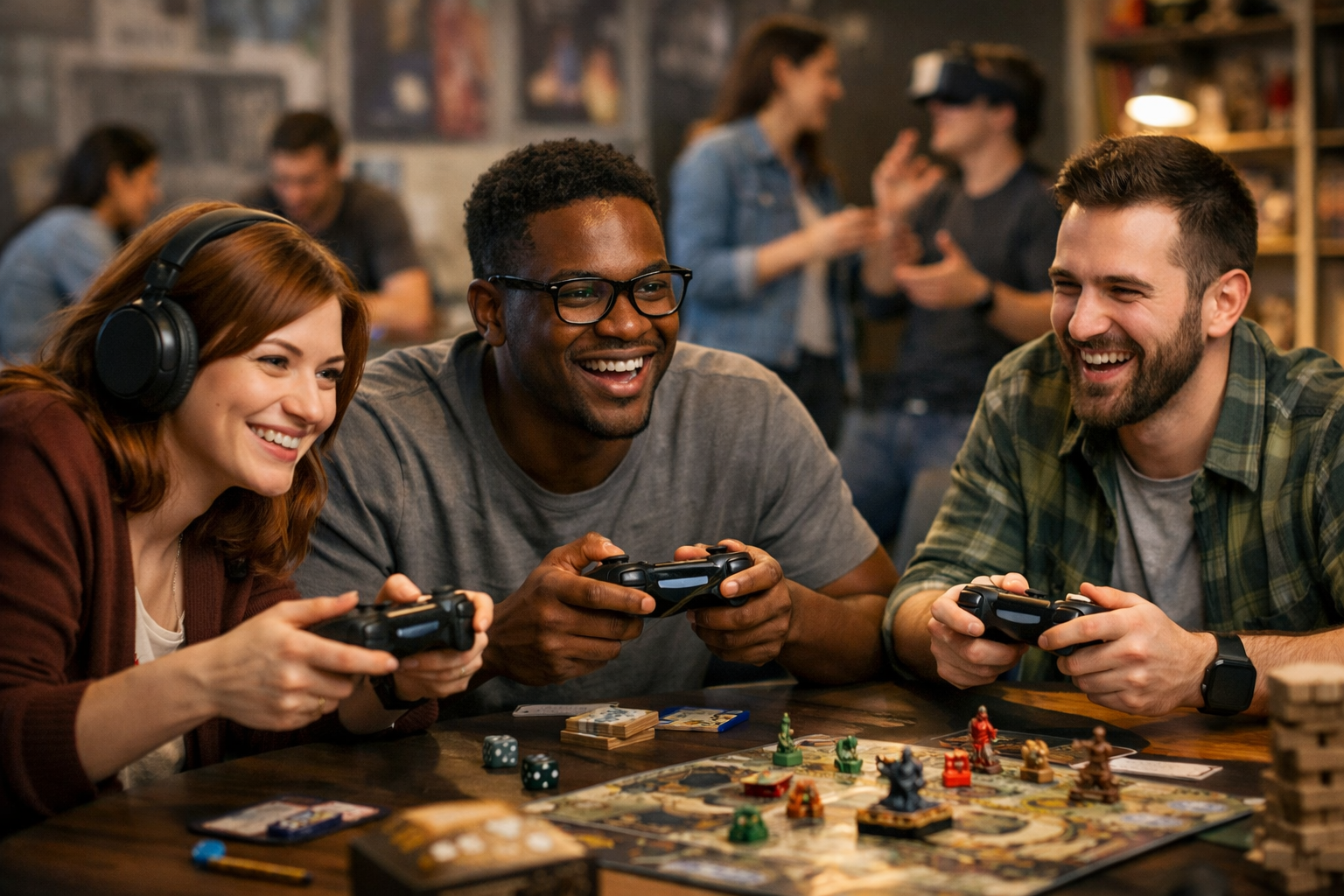
A game is a structured activity with goals, rules, and feedback, where players make meaningful choices. That definition covers everything from tag on a playground to chess, soccer, word puzzles, and massive online video games. What distinguishes games from open-ended play is the presence of constraints—rules that narrow possibilities—and a measurable outcome, whether it’s a score, a win condition, or a completed challenge.
Games also create a “magic circle,” a shared agreement that actions inside the game have a specific meaning. Moving a wooden token, placing a card, or clicking a digital button becomes significant because everyone accepts the same system. This shared understanding is a major reason games can bring strangers together quickly: the rules provide common ground.
Fun matters, but it’s rarely the only reason people play. Games offer an efficient way to experience progress, mastery, and social interaction within a safe framework. Even intense competitive games can be “safe” in the sense that consequences are bounded and understood.
Different genres emphasize different motivations. A cozy simulation game may prioritize comfort and creativity, while a tactical shooter may focus on competition, reflexes, and teamwork under pressure.
Tabletop games excel at face-to-face interaction. Because information is often visible and turns are explicit, players can reflect, negotiate, bluff, and read body language. Modern board games also showcase diverse design: cooperative survival, deck-building strategy, social deduction, and narrative campaigns.
Digital games add speed, scale, and simulation. Computers can track complex systems—physics, economies, skill trees, matchmaking—and present immersive audiovisual feedback. Video games also support accessible practice through instant restarts and adjustable difficulty, which makes them powerful tools for learning-by-doing.
Sports combine play with athletic development. They cultivate coordination, endurance, and teamwork, but also emotional regulation: dealing with mistakes, momentum swings, and high-stakes moments. Informal physical games—capture the flag, kickball, skate challenges—offer similar benefits with fewer barriers.
Puzzles focus on pattern recognition, logic, and language. They can be solitary and meditative, or social and competitive. While they often lack “opponents,” they still provide structured goals and feedback, making them games in their own right.
Game design is the art of creating meaningful choices. Small rule changes can transform an entire experience: adding a timer increases urgency; hidden information creates suspense; cooperative objectives shift the tone from rivalry to shared problem-solving.
Many memorable games rely on elegant “verbs”—simple actions that combine into complex outcomes. Think of moving and capturing in chess, or running, jumping, and timing in a platformer. A strong set of verbs makes learning intuitive while keeping mastery deep.
Games are social technology. They create roles (teammate, rival, leader, support), shared vocabularies, and rituals. Competition can be thrilling and motivating, but it can also create stress or exclusion if skill gaps are large. Cooperative games, meanwhile, encourage communication and trust, but can suffer if one player “solves” everything and others feel carried.
Healthy gaming communities tend to have clear norms: respect for newcomers, consequences for harassment, and tools that reduce friction (moderation, reporting, matchmaking, or simply good table etiquette). When those supports exist, games become a durable form of social glue—weekly meetups, tournaments, or online friendships sustained for years.
Because games provide immediate feedback and repeated practice, they naturally support learning. Strategy games develop planning and probabilistic thinking; rhythm games train timing; team games practice communication under constraints. Educational games can be effective when the learning objective is integrated into the core mechanics rather than pasted on as trivia.
Beyond formal education, games can teach “soft skills”: patience, resilience after failure, and the ability to iterate. A well-designed game normalizes mistakes as part of progress—lose, learn, adjust, try again.
Like any powerful medium, games can bring challenges. Some players struggle with time management, while others encounter predatory monetization or unhealthy social dynamics. Responsible play is less about avoiding games and more about intentional habits.
Games continue to evolve through new platforms and new audiences. Cross-play connects players across devices, while accessibility features—remappable controls, subtitles, colorblind modes, difficulty options—make more games playable for more people. Advances in procedural generation and AI-assisted tools are reshaping how worlds are built, tested, and personalized.
Yet the heart of games remains constant: rules that create meaning, choices that create agency, and shared experiences that create stories. Whether you’re rolling dice at a kitchen table or exploring a digital universe, games offer a uniquely human mix of challenge, creativity, and connection.
